🏆 How to Support Your Child’s Guitar Journey (Without Becoming the Practice Police)
When kids start guitar, parents often get stuck between “helpful” and “nagging.” Here are simple, practical ways to support your child’s practice—without turning into the practice police—so learning stays fun, positive, and consistent.


When your child starts learning guitar, it’s exciting… and sometimes a little uncertain.
Most parents quickly find themselves wondering:
“How do I help without nagging?”
“How much practice is enough?”
“What if they lose interest?”
If you’ve ever felt the tension between being supportive and becoming the “practice police,” you’re absolutely not alone. The good news? Helping your child succeed with guitar doesn’t require pressure, long practice sessions, or daily battles.
In fact, the opposite is often true.
🎯 The Common Trap Parents Fall Into
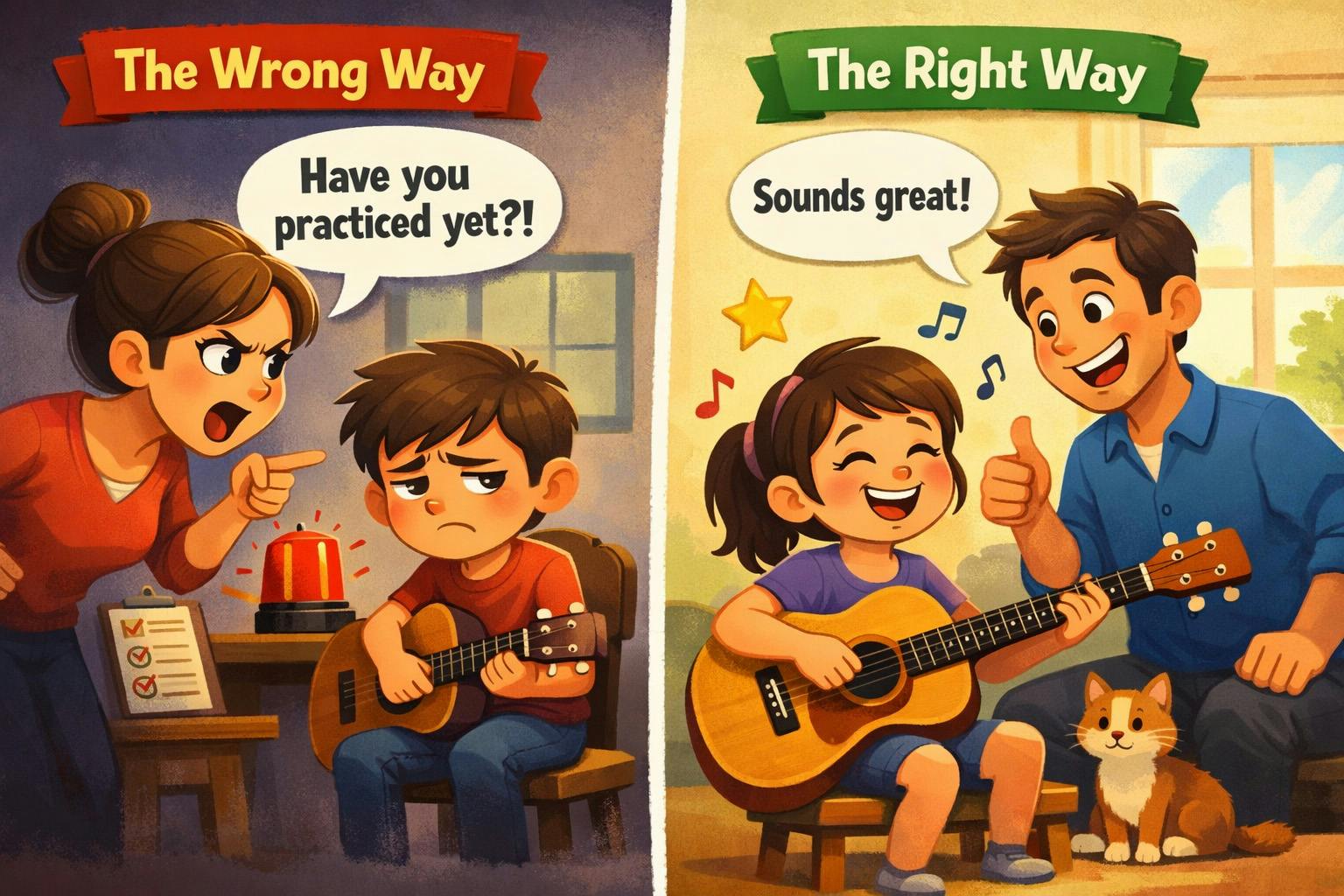
Many parents begin with the very best intentions.
You want to encourage good habits. You want your child to make progress. You want that investment in lessons (and the guitar sitting in the corner) to actually lead somewhere.
So naturally, reminders start creeping in:
👉 “Have you done your practice?”
👉 “Go grab your guitar.”
👉 “You need to practise before screen time.”
Before long, practice becomes something your child feels pushed into rather than drawn toward.
This is the trap.
Not because parents are doing anything wrong — but because pressure quietly changes how children emotionally relate to the instrument.
Guitar shifts from:
🎸 “Something fun I get to do”
to
⚠️ “Something I’m told I have to do”
And once that shift happens, resistance often follows.
💡 A Better Way to Think About Practice
What if practice didn’t need to feel like a chore at all?
For young beginners especially, progress isn’t built on long, serious practice sessions. It’s built on something much simpler:
✅ Short bursts
✅ Positive experiences
✅ Small, repeatable wins
Children thrive when guitar feels approachable and achievable — not overwhelming.
Instead of aiming for “perfect practice,” it’s far more effective to focus on:
🎯 Showing up regularly
🎯 Keeping sessions light
🎯 Ending on a good note
Even just a few focused minutes can be incredibly powerful when the experience stays fun and encouraging.
Because when kids feel successful…
They want to come back.
⏱ Why Short Practice Wins

When it comes to young children, shorter is not just “easier” — it’s actually more effective.
Attention spans are still developing. Hand muscles tire quickly. Mental fatigue sets in fast. What looks like “lack of discipline” is usually just… being a kid.
Short practice sessions work because they:
✅ Match a child’s natural focus window
✅ Prevent frustration and overload
✅ Create frequent feelings of success
✅ Build consistency without resistance
A 3–5 minute session done regularly will almost always outperform a 20-minute battle filled with sighs, distractions, and tension.
Why?
Because success fuels motivation.
And motivation fuels consistency.
And consistency is where real progress lives.
🌱 Progress Over Perfection
One of the most powerful mindset shifts for parents is this:
👉 Progress matters far more than perfection
Early guitar learning isn’t about flawless playing. It’s about:
✅ Building familiarity
✅ Developing coordination
✅ Growing confidence
✅ Creating positive associations
There will be missed notes. Awkward finger placements. Stop-start rhythms.
That’s not failure — that’s learning.
When parents celebrate effort instead of accuracy, children begin to feel:
🎸 “I’m getting better”
instead of
⚠️ “I’m getting it wrong”
And that emotional difference is enormous.
Because confident kids keep playing.
Self-critical kids often withdraw.
🎯 How Parents Can Gently Support Practice
Supporting your child’s guitar journey doesn’t require pressure, strict schedules, or constant reminders. Small, thoughtful actions are far more powerful.
Here are some simple approaches that work beautifully:
✅ 1️⃣ Keep Practice Light
Think “invitation,” not “instruction.”
👉 “Feel like playing your guitar for a few minutes?”
Tone matters more than wording.
✅ 2️⃣ Focus on Consistency
Regular contact beats rare marathons.
✔ A few minutes most days
❌ One long session once a week
✅ 3️⃣ Celebrate Small Wins
Progress at this stage is subtle but important.
👏 “That sounded great!”
👏 “Nice rhythm!”
👏 “Your fingers are getting quicker!”
✅ 4️⃣ End on a Positive Note
Stop before fatigue or frustration sets in.
Always leave them feeling:
🎸 Successful
😄 Encouraged
✨ Willing to return
✅ 5️⃣ Remove Pressure
Practice should feel safe, not judged.
Kids stay engaged when guitar feels like:
🎵 Exploration
🎮 Play
🎉 Achievement
Not:
⚠️ Evaluation
⚠️ Obligation
⚠️ Performance stress
🎸 How Kids Guitar Dojo Supports This Naturally
This understanding of how children learn is exactly why Kids Guitar Dojo was designed the way it is.
Rather than relying on long practice sessions or rigid expectations, the program is built around:
✅ Short, achievable lessons
✅ Clear, simple instructions
✅ Frequent feelings of success
✅ Positive reinforcement
✅ Playful progress tracking
Everything is structured to help children experience momentum — that rewarding sense of:
🎸 “I can do this.”
Because when learning feels manageable and encouraging, practice stops being a struggle and starts becoming something children willingly return to.
And that’s where confidence truly begins to grow.
✨ Final Thoughts
Your role as a parent isn’t to enforce practice like a drill sergeant.
It’s to create an environment where learning feels:
🎸 Safe
😄 Encouraging
🌱 Positive
Small moments of support, patience, and celebration often have a far greater impact than strict routines or constant reminders.
Because when children associate guitar with enjoyment and success…
They keep playing.
And when they keep playing…
Progress takes care of itself.

Ready To Start Your Guitar Journey