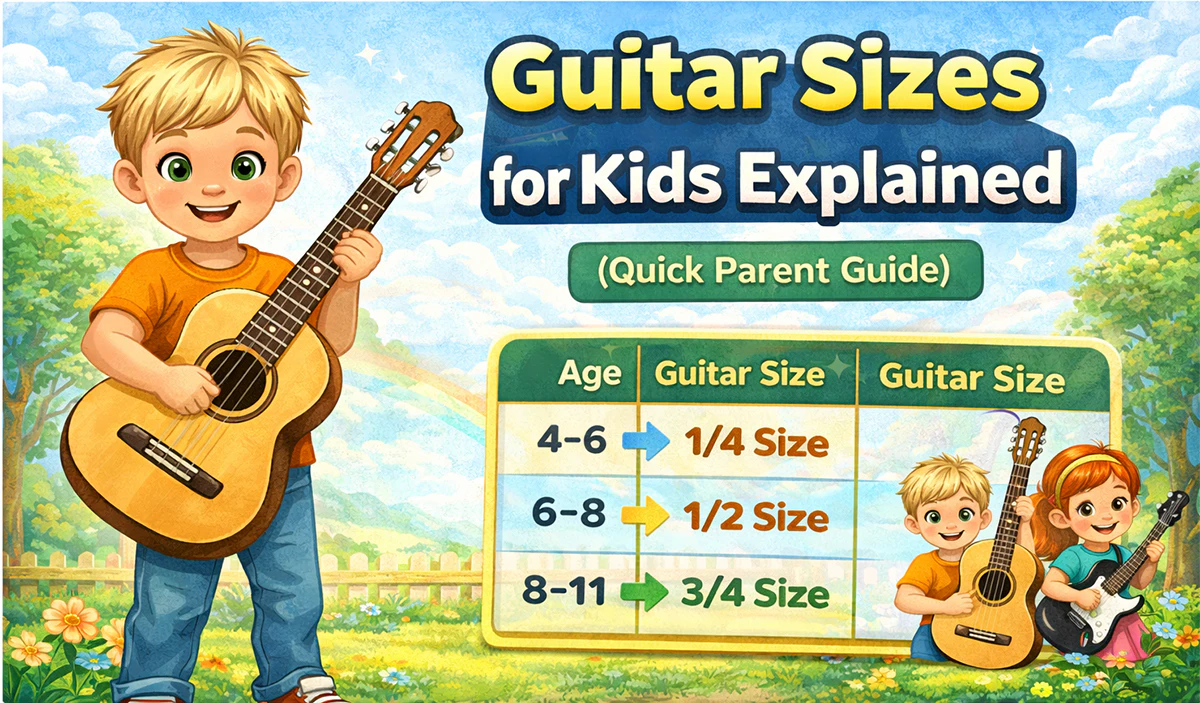
Electric vs. Acoustic Guitars for Beginners (Ages 5–12): A Parent's Starter Guide
Choosing between an electric and acoustic guitar for your child doesn’t need to be complicated. Both are great first instruments — the key is finding a guitar that fits comfortably, is easy to play and makes your child want to practise.


Here’s what parents need to know before buying that first guitar.
🎸 Can Kids Start on an Electric Guitar?
Absolutely.
The old idea that beginners need to “pay their dues” on an acoustic guitar before moving to electric is outdated.
A properly sized electric guitar can be just as beginner-friendly as an acoustic — and for some children, it can actually be easier to play.
Electric guitars typically have lighter strings, slimmer bodies and relatively comfortable necks. Short-scale models also reduce the distance between the frets, which can help smaller hands.
The better question isn’t “Should beginners start on acoustic?”
It’s:
Which guitar is going to make my child want to pick it up again tomorrow?
🎵 Acoustic vs. Electric Guitar: What’s the Difference?
Both instruments teach the same fundamental guitar skills.
For a young beginner, the differences that really matter are:
🤏 String Tension & Sore Fingers
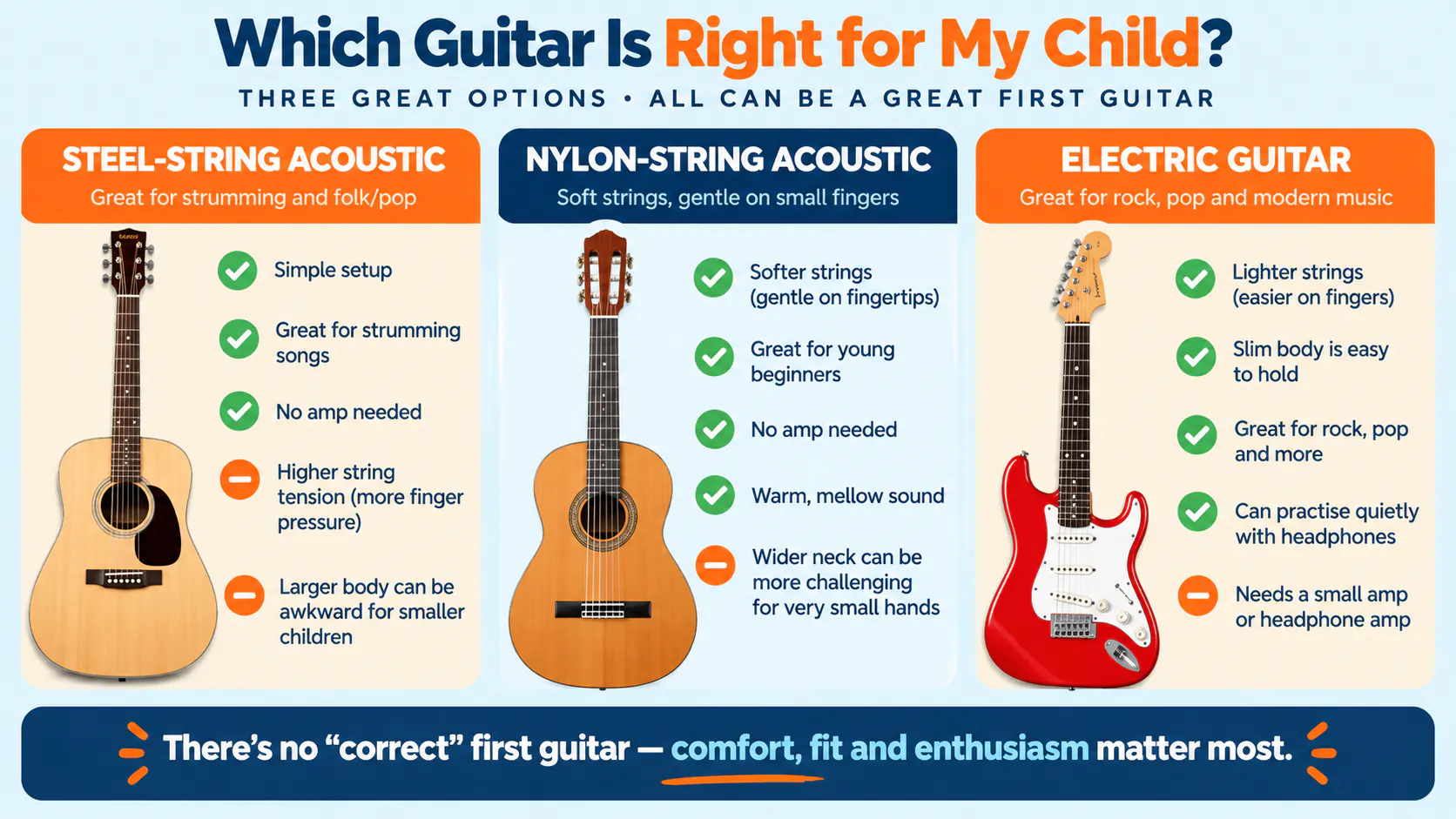
Steel-string acoustic: Usually requires more finger pressure, particularly for young beginners.
Electric: Generally uses lighter strings and can be easier for small fingers to press down.
Nylon-string acoustic: Soft nylon strings are particularly gentle on beginner fingertips.
Some fingertip tenderness is normal when learning guitar. But playing shouldn’t feel like a battle.
If your child continually struggles to press the strings down, check the guitar size, string type and setup rather than assuming they simply need stronger fingers.
📏 Body Size & Comfort
Acoustic guitars are generally lightweight, but their deep, rounded bodies can be awkward for small children to reach around.
Electric guitars are usually heavier, but their bodies are much thinner.
For some young players, that thin body makes an electric surprisingly comfortable to hold.
✋ Neck Size & Small Hands
Electric guitars often have relatively slim necks, while traditional classical guitars tend to have wider necks.
That means nylon strings may be easier on the fingertips, but the wider neck can sometimes be more challenging for very small hands. Yamaha also notes that classical guitars generally have wider necks and that this can make them harder for smaller hands to navigate.
This is why guitar fit matters more than simply choosing acoustic or electric.
📐 What Size Guitar Does My Child Need?
Not sure which size your child needs? Start with our complete guitar size guide for kids, including a simple size chart and fit checklist.
Don’t buy a full-size guitar simply because your child will “grow into it.”
A guitar that’s too large can make learning unnecessarily difficult.
You’ll commonly see children’s guitars described as:
1/2 size • 3/4 size • Mini • Short Scale • Full Size
These are useful starting points, but don’t choose a guitar by age alone.
Children of the same age can have very different heights, arm lengths and hand sizes.
Fender recommends scaled-down instruments for smaller children and notes that mini models can be particularly suitable for children around 6–10. Yamaha similarly recommends checking whether the player can comfortably reach the end of the fretboard.
Fit the guitar to the child — not simply their age.
🤚 The 60-Second Guitar Fit Test
Want the sizes at a glance? See our quick guide to 1/4, 1/2, 3/4 and full-size guitars for kids.
You don’t need to play guitar yourself to check whether an instrument is too big.
Have your child sit down with the guitar and check these three things.
1️⃣ Does It Sit Comfortably on Their Lap?
The guitar should feel stable.
Your child shouldn’t have to hunch over it, lean backwards or continually stop it from sliding away.
2️⃣ Is Their Strumming Shoulder Relaxed?
Their strumming arm should rest naturally over the guitar.
If their shoulder is pushed upwards toward their ear, the body may be too large or deep.
3️⃣ Can They Easily Reach the First Fret?
Ask your child to reach the first fret near the tuning pegs.
Their arm and wrist should remain reasonably relaxed.
If their whole body has to stretch sideways to reach it, try a smaller guitar.
Comfortable? You’re probably in the right ballpark.
🎛️ One Thing Parents Often Miss: Guitar Action
Here’s one useful guitar term every parent should know:
Action.
Action simply means how high the strings sit above the fretboard.
If the strings are too high, your child has to push much harder to play a note.
A poorly set-up guitar can therefore make learning far more difficult than it needs to be.
When buying from a music shop, simply ask:
“Could you check that the action is comfortable for a young beginner?”
You don’t need to know anything more technical than that.
🎧 Is an Electric Guitar Too Loud for Home?
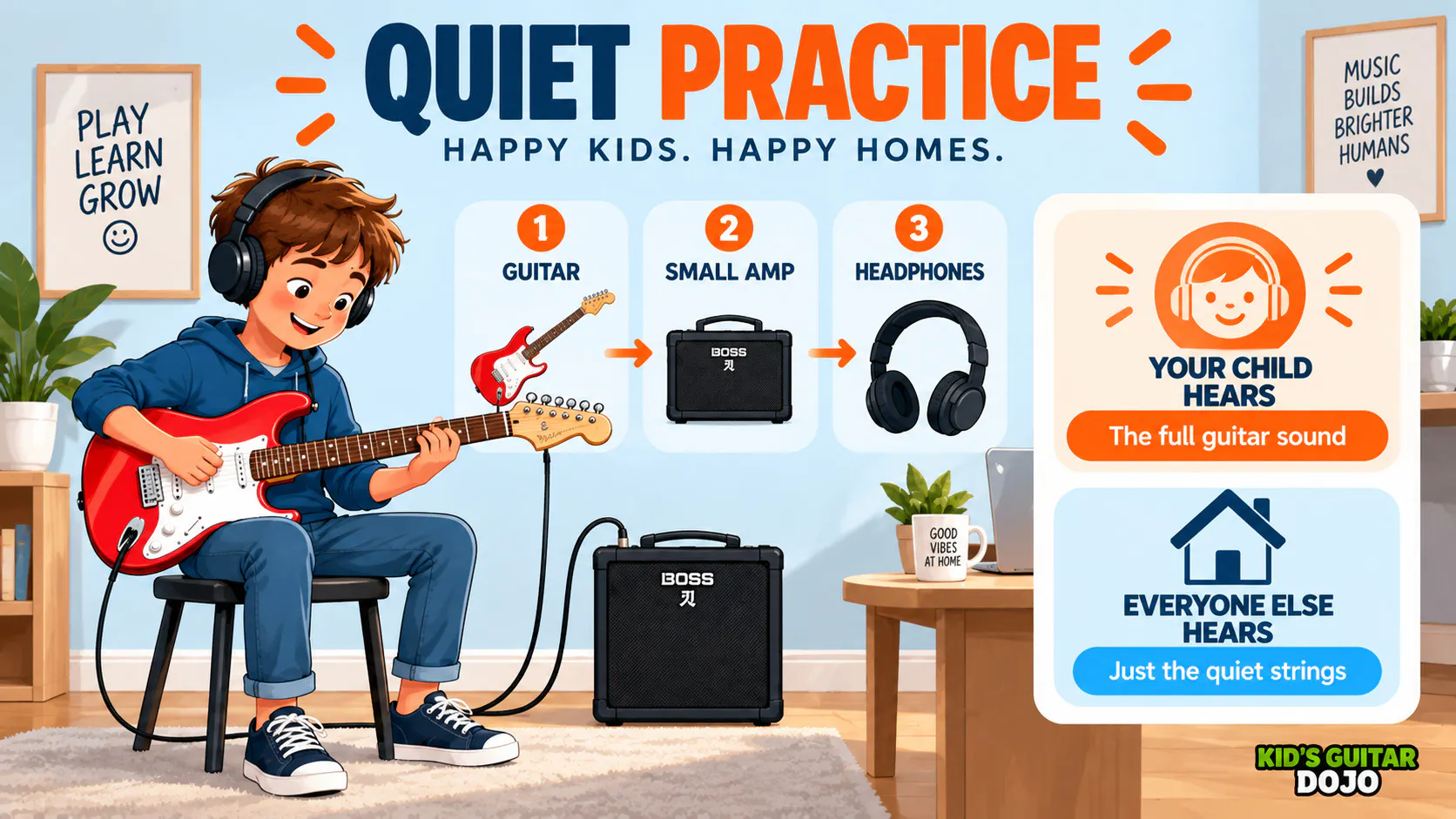
Here’s the surprising part.
An electric guitar can actually be the quieter option.
Connect it to a small practice amp with headphones and your child hears the amplified guitar while everyone else hears little more than the quiet sound of the strings themselves.
That can be fantastic for:
Apartments • siblings • homework time • work-from-home parents • early-morning practice
Fender specifically highlights headphone practice as an option with children’s electric-guitar setups.
And there’s another benefit.
Headphones give children the freedom to experiment, repeat the same riff 25 times and make mistakes without feeling as though everyone is listening.
🔊 Does My Child Need a Big Guitar Amp?
No.
You definitely don’t need a wall of Marshall stacks in the bedroom.
A small practice amp with a headphone output is more than enough for a beginner.
Another option is a compact headphone guitar amp that plugs directly into the guitar.
That makes an electric setup surprisingly small.
🎒 What Equipment Does a Beginner Need?
Keep it simple.
🎸 Acoustic Guitar Starter Kit
Guitar • Clip-on tuner • Picks • Gig bag
That’s really all you need to get started.
⚡ Electric Guitar Starter Kit
Guitar • Small practice amp or headphone amp • Guitar cable • Clip-on tuner • Picks • Gig bag
A child-sized adjustable strap is also useful.
Forget effects pedals and expensive accessories for now.
You can always add those later.
🎼 What About Nylon-String Guitars?
There’s actually a third option between the usual acoustic-versus-electric debate.
A nylon-string or classical guitar can be an excellent first instrument for children.
Nylon strings feel softer under the fingertips than steel strings, which is one reason they’re commonly used for young beginners.
However, classical guitars usually have wider necks.
So while the strings are softer, the neck can require a bigger hand stretch.
For a very young child, try the guitar rather than assuming nylon automatically means easier.
🖐️ What If My Child Gets Sore Fingers?
A little fingertip tenderness is normal when someone first starts playing guitar.
But persistent discomfort is worth investigating.
Before telling your child to “push through it,” check:
Are the strings too heavy?
Is the action too high?
Is the guitar too large?
Would lighter electric strings or nylon strings be more comfortable?
The goal isn’t to toughen up their fingers as quickly as possible.
The goal is to keep them playing.
🏷️ Don’t Buy a Toy Guitar
There’s an important difference between a small guitar and a toy guitar.
A child’s first guitar doesn’t need to be expensive, but it should:
Stay reasonably in tune • Produce clear notes • Have working tuners • Be comfortable to hold • Be reasonably easy to press
A badly made instrument can make a beginner think they’re doing something wrong when the guitar is actually the problem.
You don’t need a professional guitar.
You do need a playable one.
🌈 Can Kids Use Fretboard Stickers on Electric and Acoustic Guitars?
Yes.
Visual fretboard markers can make it much easier for young children to understand where their fingers need to go.
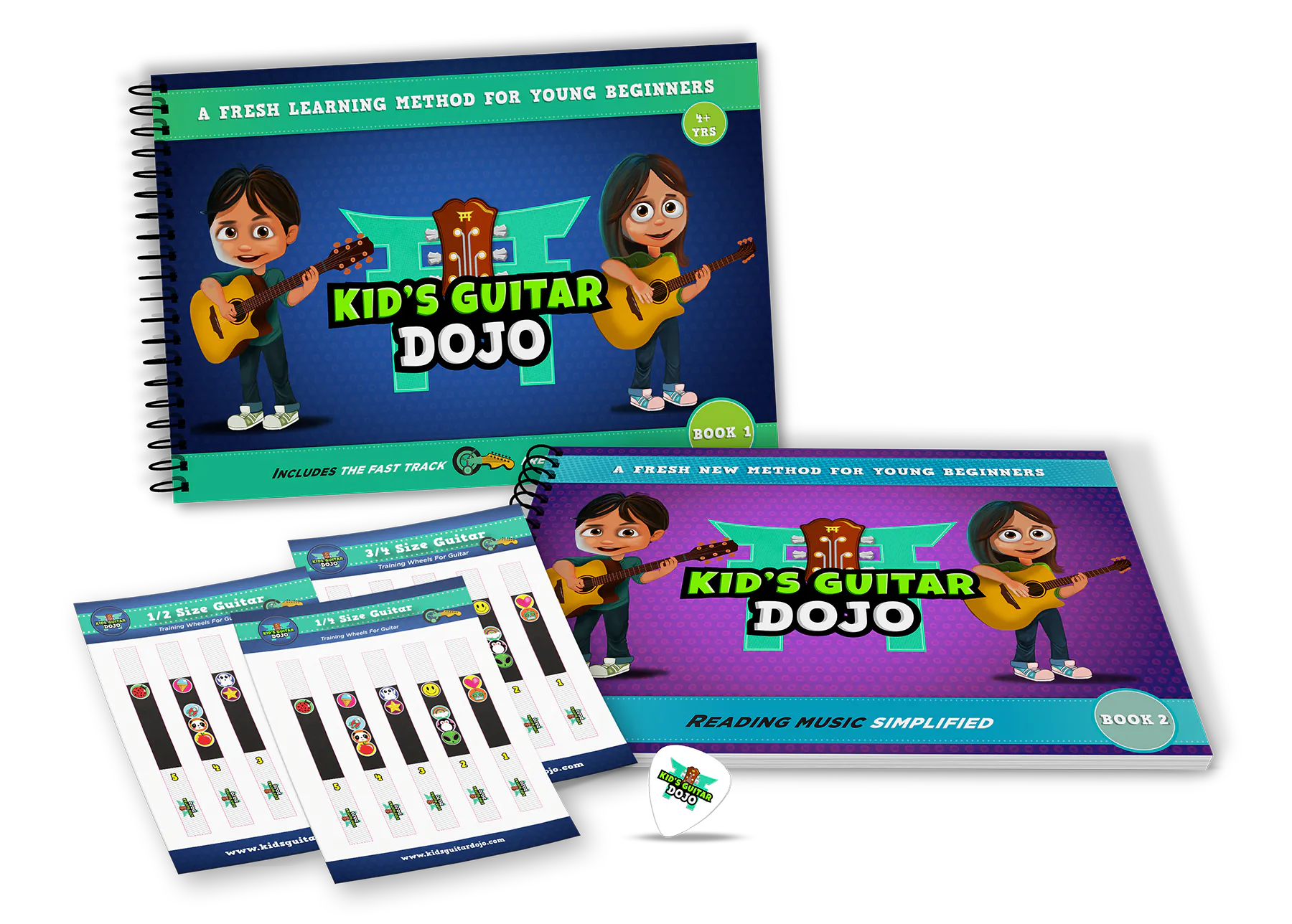
The Kids Guitar Dojo Fast-Track Fretboard System works like “training wheels for guitar,” giving children a visual guide while they develop their fretboard skills.
One important point:
Don’t assume every guitar labelled “3/4 size” has identical fret spacing.
Check the guitar’s actual scale length and fret spacing when choosing your markers.
The system can work with either acoustic or electric guitars when correctly sized.
🎨 Should I Let My Child Choose Their Guitar?
Yes — within reason.
First make sure the guitar is:
The right size • Comfortable • Playable • Within your budget
Then let your child have some input.
Colour matters.
Shape matters.
And whether your child thinks their guitar looks incredibly cool definitely matters.
Adults sometimes dismiss those things as superficial.
For an eight-year-old deciding whether to pick up their guitar after school, they’re called motivation.
Know the size and guitar type you need? Next, see our guide to choosing a beginner guitar for kids by size, with acoustic, nylon-string and electric options.
Still Not Sure Which Guitar to Choose?
🎯 So, Is Electric or Acoustic Better for a Beginner?
Both can be excellent first guitars.
For children aged 5–12, don’t worry too much about whether tradition says they should start on acoustic.
Instead, look for a guitar that’s:
✓ The right size ✓ Comfortable for small hands ✓ Properly set up ✓ Suitable for your home ✓ Appropriate for the music they love
Then ask one final question:
Does this guitar make my child want to pick it up and play?
If the answer is yes, you’re probably looking at the right first guitar.

Ready To Start Your Guitar Dojo Journey?